Walking space
Urban Design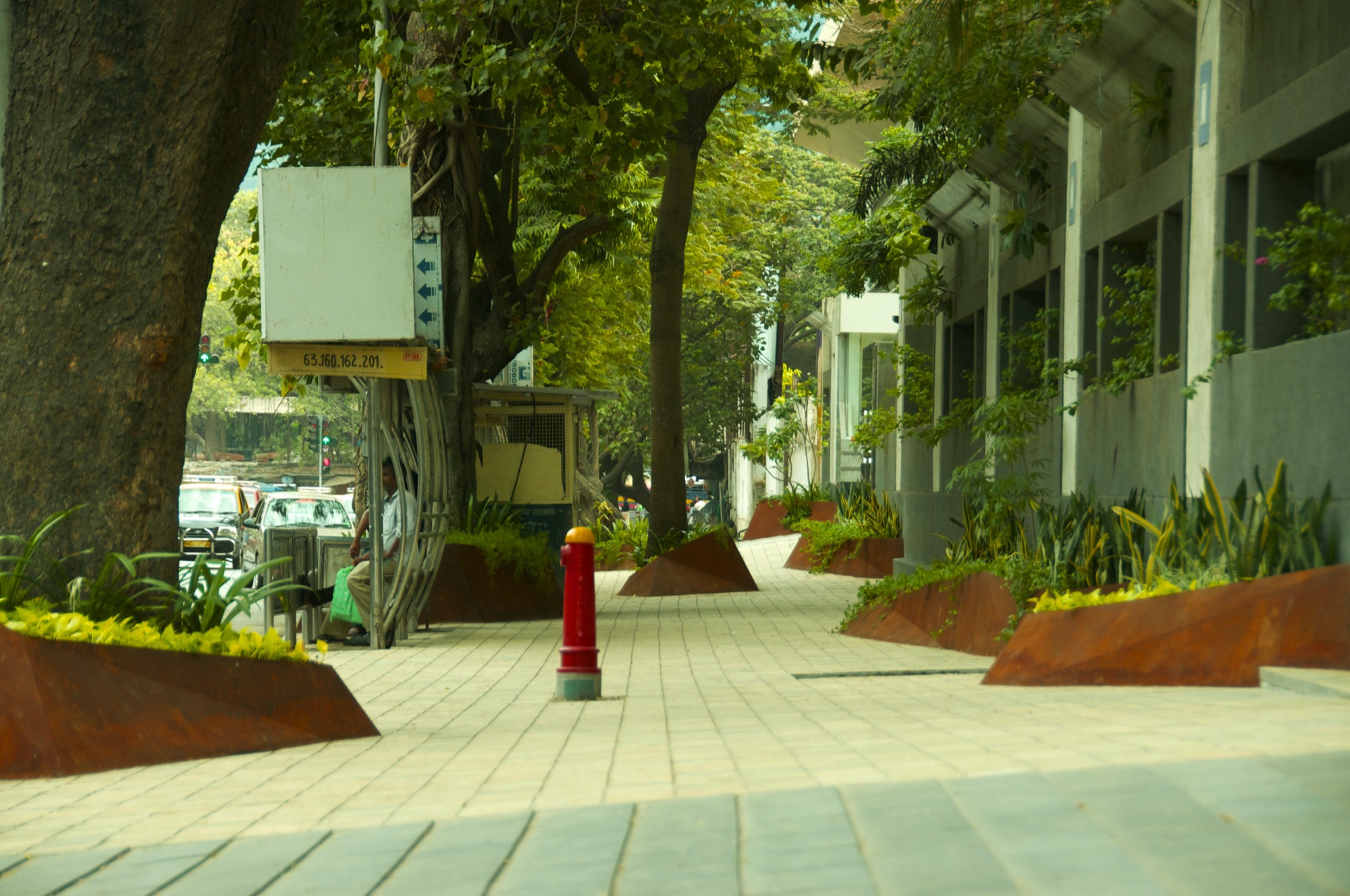


This undulating cor-ten steel landscape project is an interface between the once-working class street of eastern Prabhadevi, and the slick facade of the Motilal Oswal tower. The idea of not having to walk a long length in a necessary straight line plays an important part. The planters themselves present a lush green space to walk through at any time of the day or night.
Socially relevant In Mumbai, sidewalks are often lost between the street and the buildings. The sidewalk, whether existent or not, signifies the meeting point. This project was aimed at giving the city its first designated walking space. The area around the site has a multitude of offices, and is a thoroughfare. Lines of walkers, weary travelers, and children make for all the paved area. The rest of the space is given to the trees and greenery. The vendors on site were involved in the design and construction process and now they have a sense of ownership in the space.
The project stemmed from a desire to contribute positively to Mumbai. To prove that walking spaces can be made comfortable and maintenance free, at the civic budget, and a construction rate of 100sq.ft per day. Attempting to look at the root cause of the problem, and solve it there. We wish not to impose our will, but present a solution that takes into account every user of the space.
Landscape In Mumbai, sidewalks are often lost between the street and the buildings. This project was aimed at giving the city its first designated walking space. The space for the trees is sacred; each is given many times its own trunks’ area to grow. The space under the plants has been excavated until the surface soil below, a buffer water space, and filter layer are incorporated before adding another layer of soil and plants above. local, fast growing, and sturdy species of plants are used. The excess water from the plants nourishes the trees. The plants occupy a sixth of the area, and replenish groundwater. 8mm thick faceted weathering steel is welded together to make high strength rings. These are left untreated to change with the seasons..
The project stemmed from a desire to contribute positively to Mumbai. To prove that walking spaces can be made comfortable and maintenance free, at the civic budget, and a construction rate of 100sq.ft per day. Attempting to look at the root cause of the problem, and solve it there. We wish not to impose our will, but present a solution that takes into account every user of the space.
Walkway at Prabhadevi. – essay The streets of Bombay, like all of India have blurry edges. Between the street and the buildings, it is often the sidewalk that loses its form. The road consumes the edges; buildings overshadow the street and introduce breaks in the space. Neither of these built spaces serves the real population1, who walk, and use public transport. The sidewalk, whether existent or not, signifies the meeting point, it is the companion of all. The ever-vanishing footpath is the face of the city. After all What is the city but the people?2 The walkway at Prabhadevi grew from months of walking, slipping and tripping. It can be best described as three parts each with equal importance- the Act of Walking, Surface, and Biology. The surface of Bombay’s streets was for 100 years paved with a limestone from Shahbad. The 21st century saw the proliferation of the interlocking paver in the city. Good limestone was removed, and replaced with poor quality uneven concrete. We brought back the stone, changed the format to a 7x7” size, and increased the thickness. Placed on a leveling layer of concrete, it makes the walking surface free of potholes, kinks, and is virtually indestructible. The stone is not treated, is set in with 6mm grooves, 6mm deep. The laid out stones are locked in with curbstones. Wherever utilities puncture the surface, the grid is left unbroken and locked in with a low-grade concrete finished with pea gravel. The height of the edge is maintained at roughly four inches below the level of a typical low-slung car. The act of walking when recorded, leads to a very interesting pattern. Most do not walk a straight line. The area around the site has a multitude of offices, and is a thoroughfare between these and the transport hub of Dadar. Office goers are often the fastest, and take the straightest line. The teenagers, with potential energy find comfort in the shade, and walk towards the center, they may go back after finding their friends, or walk towards Shivaji Park. Travellers to other cities also find this a good spot to wait on travelling companions. Children and their mothers are by far the most circuitous- this demographic got a lion’s share of playfulness. The lines of walkers, weary travellers, and children make for all the paved area. The rest of the space must be reserved for the trees. The oldest occupants of the space enjoy a smoother, more comfortable frontage, which works well for street side business. The vendors have a sense of ownership in the space now that they have been a part of the construction process. At the studio we believe in responsible stewardship of nature, because what is created, is to be protected3. The goal was to have 15% green space at the base of the trees. The space for the trees is sacred; each is given many times its own trunks’ area to grow. The faceted steel forms rings around the trunks to guide the growing roots. The space in between has been excavated until the surface soil below, a buffer water space, and filter layer are incorporated before adding another layer of soil and plants above. Plants used are local species, fast growing, and very sturdy. The excess water from the plants nourishes the trees. The plants occupy a sixth of the area, and replenishes groundwater. The faceted steel surface is 8mm thick weathering steel; it is welded together to make high strength rings. These are left untreated to change with the seasons, going from a bright orange in the monsoon, to a burgundy in spring. Sunlight filters into the walking space through the tree canopy; it is softened and toned by the trees. It shines down onto the plants in the day, lights in the plants make them glow, and light up the tree trunks at dusk. Walkers groups, national newspapers, and people who use this sidewalk everyday have hailed it as an ideal walking space. Years of discomfort tend to make us ignorant of the inconveniences we face everyday; we often take our situation for the norm, and fail to recognize decay. For studio | pomegranate, the walking space was a project that stemmed from a desire to contribute positively to the city of its inception. To prove that walking spaces can be made comfortable and maintenance free, at the civic budget4, and a construction rate of 100sq.ft per day. At the studio we attempt to look at the root cause of the problem, and solve it there. We wish not to impose our will, but to merely present a solution that takes into account every user of the space. We have made one such space safe, while the edges and divisions between the spaces remain notionally blurred. Footnotes: • 55% of the population of 12.5 Million in Mumbai walks as a mode of transport according to the people’s vision document for Mumbai 2014. • Shakespeare, William, The tragedy of Coriolanus. New Haven [Conn.: Yale University Press, 1924. 1975. • Dnyaneshwari, chapter 9, verse 122 • Civic Supplier information, 2013.
Studio Pomegranate was set up in 2013 by Shweta Chhatpar Shah and Pranav Naik. It is persistently exploring opportunities and potential for integrated collaborative design. We continually refine our design process to better the skillsets of everyone involved in our projects. We strive to discover and reinforce the passion of the people we work with - whether it is a search for meaning in design, the desire to serve out community, sharing knowledge and experience, or understanding the power of new software applications.
Environmental appropriateness is an underlying theme in everything we do. Sustainable design is the basis for decision making in our projects, from orientation, material selections, and systems options, to understanding the entire life cycle of the building so that it can adapt as programs change.
Shweta Chhatpar Shah graduated with her Master of Architecture from Savannah College of Art and Design, USA, specializing in Digital Architecture. She is the author of ‘Digital Urbanization of a Potter‘s Colony’, Slum Redevelopment, Dharavi, Mumbai.
Pranav Naik graduated with a Masters degree in Architecture from Taliesin, The Frank Lloyd Wright school of architecture, USA. Pranav has extensive experience with projects of varying sizes. He has hand built buildings and structures, thus giving him unique practical knowledge of building. He is a part of a fellowship of Organic Architects worldwide that work toward a better understanding of the planet, and build buildings that belong to their sites. Pranav is a studio mentor at Rachana Sansad's Academy of Architecture, Mumbai.


Project Details
- Typology
- Urban Design
- Studio
- Studio Pomegranate