Cameo Bar, and Restaurant
Hospitality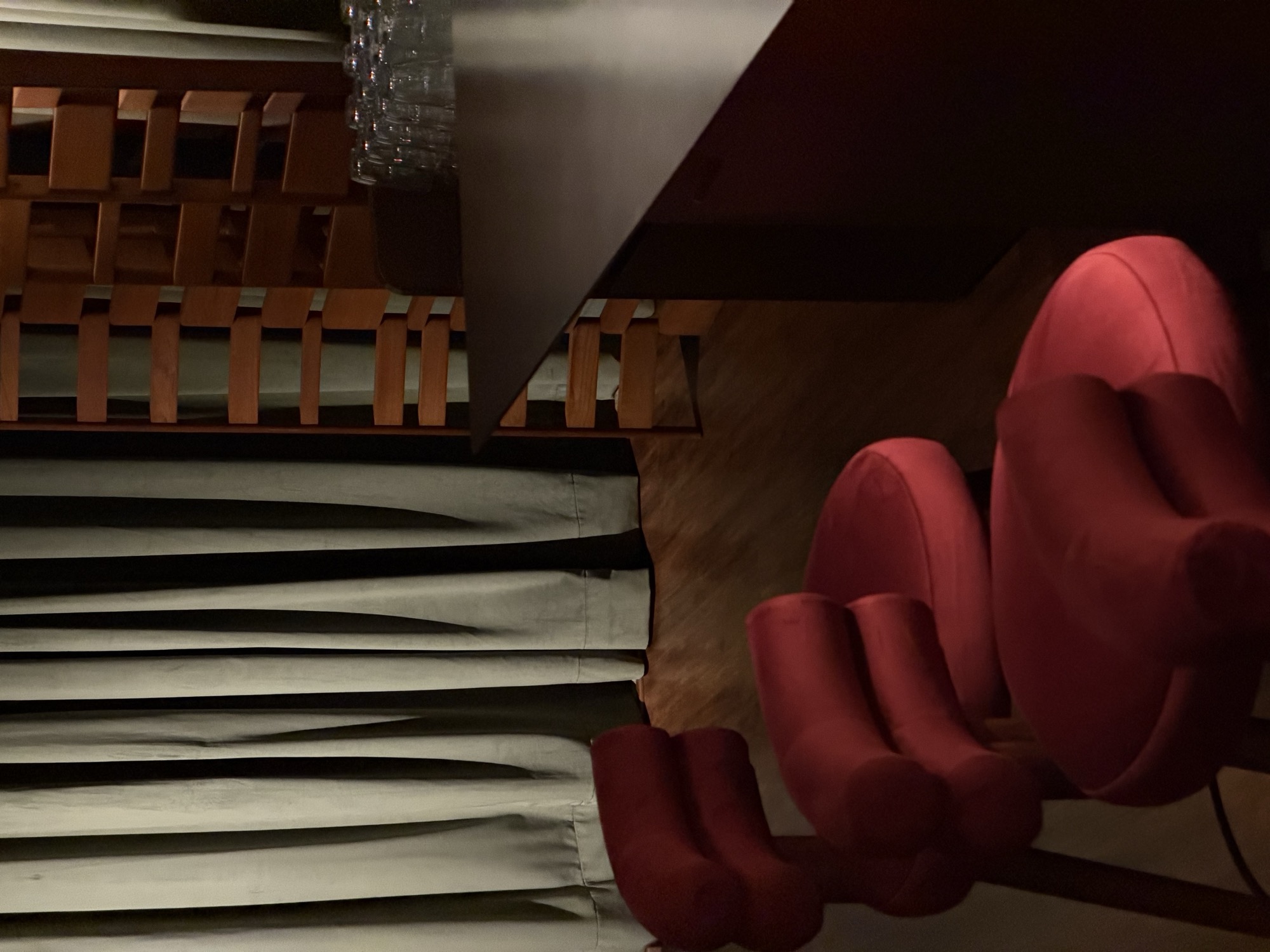


It was Alok Shetty of Bhumiputra who first suggested a visit to the Museum of Art and Photography in Bengaluru. What followed was less a casual afternoon at a gallery and more of a slow reckoning with a building that had been thought about carefully from the ground up. The Museum of Art and Photography, known simply as MAP, opened to the public in February 2023. Designed by Mathew and Ghosh Architects, with structural engineering by BL Manjunath, the building sits in Bengaluru’s museum quarter, just outside Cubbon Park. It is a considered building: functional, industrial in its material honesty, and generous with natural light in the gallery and sculpture spaces. The exposed ducts at the rear create an unintentional composition that rewards anyone who takes the time to look. From the outside, the stainless-steel clad cuboid reads almost as infrastructure, which is precisely the point. On a constrained urban plot, this is a building that earns its presence quietly. Behind MAP is Abhishek Poddar, an industrialist and collector who has been acquiring art since his teenage years in Calcutta, and who has spent much of his life building relationships with artists and craftspeople across South Asia. By 2006 he had founded Tasveer, a gallery in Bengaluru focused on contemporary Indian photography. The museum itself was a longer ambition. An early plan to revive the government-owned Venkatappa Art Gallery through a public-private partnership fell through after public objections, and Poddar decided to build from scratch on his own terms. To fund it, the Poddar family auctioned a significant portion of their personal art collection through Christie’s in 2016, and construction began in 2018. The pandemic pushed the opening by years. MAP finally opened in February 2023, with a founding collection that Poddar had gifted entirely to the institution. It is a collection of over 60,000 works spanning painting, sculpture, photography, textiles, folk and tribal art, and Bollywood memorabilia, assembled over decades and given away without reservation. The building is the physical expression of that commitment. Working with Poddar on Cameo, it became clear that he is someone who arrives at a project with strong convictions and specific ideas, and who is also genuinely willing to be in conversation about them. He pushed back, took push back, and engaged seriously with the thinking of everyone in the room. That quality is part of what made the collaboration produce something coherent. The opportunity to design Cameo, both the bar and the bistro on the building’s rooftop, came with a clear responsibility. The spaces had to grow out of the existing aesthetic rather than sit on top of it. There is a personal relationship between the studio and the architects and structural engineer of the building, and from the beginning, the design process was in active conversation with Soumitro Ghosh and BL Manjunath. Poddar was equally insistent that the interventions acknowledge what was already there. What emerged from those conversations was a guiding principle: Cameo would be a continuation of the museum’s architectural language. The project was driven from the client side by Guru Shivaram, Salman Sait, and Amrit Hemdev of Investorant. The bar programme was led by Hemant Mundkur, and the food across both spaces was conceived by Kanishka Sharma and Pallavi Menon, the chef-founders of Navu. On the Studio Pomegranate team, the project architect was Nikita Shahdadpuri, with Tanya Chowhan managing construction on site. Each space was built out in approximately two weeks, a timeline that demanded precision and trust between every person involved. The Bar The bar occupies what was previously the museum’s members’ lounge, a space that by day remains exclusive to members, and by night opens to reservations from the general public. The existing space had two ceiling conditions: a sloping roof on one side and a flat industrial ceiling on the other, creating a significant variation in height. The design response was to work with that difference rather than against it, using a mirrored surface applied in undulating panels at various angles to soften the relationship between the two planes and give the room a unified character. The principle behind the mirrors is one of incident vision. By ensuring that the panels never return a direct reflection, the room resists any single reading of its dimensions. Colour enters not through a fixed palette on the walls, but through what the room already contains: the clothes people wear, the glassware on the bar, the light coming in from the terrace. Reflections appear in unexpected places, pulling warmth and movement into corners where the eye does not expect to find them. The walls were painted a deep green and the floor finished in timber, giving the space an anchor of colour and material warmth from which the mirrored surfaces work outward. The overall effect is a room that feels at once intimate and expansive, without being either too small or too large to inhabit comfortably. The existing furniture was from Phantom Hands, well made and worth keeping. Rather than replace the pieces, the studio chose to reupholster them in brighter colours, allowing the seating to contribute to the room’s palette without overwhelming it. The rest of the colour, as intended, belongs to the guests. It is a generous decision, and one that gives the room a different character on every visit depending on who is in it. The bar counter is constructed in brushed stainless steel, fabricated from a single 6mm sheet. The mass of a single sheet gives it a solidity that assembled or lighter metal surfaces rarely achieve. A bar counter should feel permanent, and this one does. The proportion of the counter was equally considered. The intent was to reduce the distance between guest and bartender, creating the conditions for conversation rather than transaction. This is an idea the studio had worked through previously at Bar Spirit Forward, where a counter of solid granite, laid narrow, produced the same closeness through a different material. At Cameo, the stainless steel additionally serves as a reflective surface, extending the visual logic of the mirrored ceiling down to the working plane of the bar. The bar was fabricated by Studio Vinton in Kochi, whose execution matched the ambition of the brief. The bar back was conceived as cantilevered glass shelves carrying dichroic film, drawing directly from the museum below, where Poddar had specified a dichroic coating on the glazed circulation deck that casts shifting, colour-saturated light across the stairs throughout the day. The intention was to pull that material conversation up into the bar, dissolving the shelving into light and reflection and creating a continuous dialogue between the two floors of the building. The shelves read as a quiet extension of the museum’s own material logic, and the bottles and glassware they hold become part of the room’s optical life. The ceiling panels are fabricated in a reflective fabric with an acoustic backing, a response to the vinyl programme that runs in the space, developed in collaboration with Akhil Hemdev of On the Jungle Floor. The fabric surface continues the reflective logic of the mirrored walls while managing the acoustics of a room where music is central to the experience. A vinyl station, designed with input from On the Jungle Floor, brings a record culture into the bar that complements the music programme, which has included listening sessions, DJ sets, and conversations about the relationship between sound and place. Two papier mache tiger heads remain in the bar, in the same positions they occupied before the redesign. Against the deep green walls and layered reflections, they carry considerably more presence than they did before. One of them was used in Pili Vesha, the folk dance of coastal Karnataka in which performers paint themselves as tigers and take to the streets during Dasara and Janmashtami in honour of the Goddess Durga. The bar’s atmosphere makes that ritual history visible in a way the earlier space did not. The Air India posters currently on the walls, lent by the museum and selected and rotated by Poddar himself, will give way over time to other works from MAP’s collection, each displayed behind glass in keeping with the museum’s conservation requirements. The bar’s relationship with the institution below it is ongoing and active, and that continuity is one of the things that makes the space feel genuinely embedded in the building rather than placed on top of it. The Bistro The bistro is a long space, originally open on the sides, with the same sloping roof that characterises the bar. It operates through the day, facing outward toward Bengaluru. Large sliding aluminium windows were introduced to enclose the space, chosen for their consistency with the building’s industrial material vocabulary. The windows slide fully open in good weather, collapsing the boundary between the interior and the terrace, and making the view a part of the room. The walls were painted crimson. Each space found its own colour independently, but the outcome is a palette that works in relation across both rooms. During the day, the crimson absorbs the brightness that pours in through the west-facing windows, reducing glare and warming the room into something that feels suited to a long lunch. By evening, with the light gone from the sky, the walls deepen into a register closer to the dark green of the bar next door. The space shifts its atmosphere across the arc of the day through the simple behaviour of colour under changing light, without any intervention in the room itself. The views from the bistro take in UB City and the Bengaluru skyline. The west-facing orientation was always going to produce good sunsets, and it does. Along the parapet, a ledge-table in stainless steel, placed there originally by Mathew and Ghosh, was retained and given new bar seating. The position is excellent: elevated, unobstructed, and oriented directly toward the city. It offers single diners a place to eat with a view that most restaurant designers would have reserved for a table of four. In a city where the table for one is rarely treated as a considered amenity, the decision to keep it and make it better is a small but meaningful one. The stainless steel of the ledge connects materially to the bar counter in the adjacent space, giving both rooms a shared language without making the connection too deliberate. The chairs and tables were fully replaced. A server station housing coffee equipment anchors one end of the bistro, adding a functional centre to the room without drawing too much attention to itself. Bamboo fibre pendant lamps hang above the central line of tables, sourced locally, and provide ambient light that shifts the room’s atmosphere as the day moves into evening. The museum has added photographs and drawings to the walls, extending the curatorial relationship between the institution and the spaces it shares upstairs. The bathrooms were repainted and refurbished. Together, these decisions add up to a room that works as a café through the morning, a restaurant through lunch and the afternoon, and a quieter, more atmospheric space as the day ends and the bar next door comes into its own. On the Whole In film and theatre, a cameo is a brief appearance by someone whose presence adds something to the work without demanding the foreground. The name emerged from conversations between the team at Investorant and the museum, and it describes the project well. The bar and bistro are an added layer in a building that was already complete, and their job is to argue, through the quality of the experience they offer, that drinks, food, and culture can share a room without any of the three suffering for it. Every major decision made in the design of both spaces was made in relation to what already existed. The Phantom Hands furniture was reupholstered rather than replaced. The Mathew and Ghosh ledge-table was retained in the bistro and made better. The tiger heads were left where they stood, and the new atmosphere of the room revealed what they had always been. The materials chosen for both spaces speak to the building below rather than to any independent agenda. This restraint is not timidity. It is a considered position, and it is what allows the two spaces to feel genuinely at home in a building designed by someone else. Bengaluru has always been a city that holds its culture lightly, that absorbs influences from elsewhere and produces something that feels distinctly its own. Cameo sits comfortably in that tradition. It is a bar that takes the museum seriously, and a bistro that takes the view seriously, and a project that took the building seriously from the first conversation. The case it makes, that culture and hospitality belong together, is one the city is well placed to receive. Pranav Naik is an architect and interior designer based in Mumbai and Bengaluru. He is the principal of Studio Pomegranate.


Project Details
- Typology
- Hospitality
- Studio
- Studio Pomegranate